Quark Structure
Two charm quarks (c) and one down quark (d) bound by the strong nuclear force to form the Xi-cc-plus baryon.
The Discovery: A New Particle from the Large Hadron Collider
In a major breakthrough for particle physics, the LHCb experiment at CERN has discovered a new baryon containing two charm quarks and one down quark -- the Xi-cc-plus. With a mass of 3,620 MeV/c², this particle is approximately four times heavier than a proton, making it one of the heaviest baryons ever observed.
The detection achieved 7-sigma statistical significance, far surpassing the 5-sigma threshold -- the gold standard for claiming a discovery in particle physics. From 915 candidate events identified in proton-proton collision data, scientists reconstructed the particle by tracking its decay products through the upgraded LHCb detector.
This is the first new particle found with the upgraded LHCb detector from Run 3 data, and only the second baryon with two heavy quarks ever observed. The particle flashes in and out of existence in less than a trillionth of a second, yet leaves detectable traces as its decay products travel through the instrument.
Why This Matters
Baryons with two heavy quarks are a unique laboratory for testing quantum chromodynamics (QCD) -- the theory describing the strong nuclear force that binds quarks together. While most familiar baryons like protons and neutrons contain only light quarks, the Xi-cc-plus offers a window into how heavy quarks behave when bound into matter.
The discovery also validates the capabilities of the upgraded LHCb detector. The new system can read out data at the full 40 MHz collision rate -- 40 times faster than before -- allowing it to process 30 times more data per second and dramatically increasing its sensitivity to rare particle decays.
The Upgraded LHCb: The Instrument Behind the Discovery
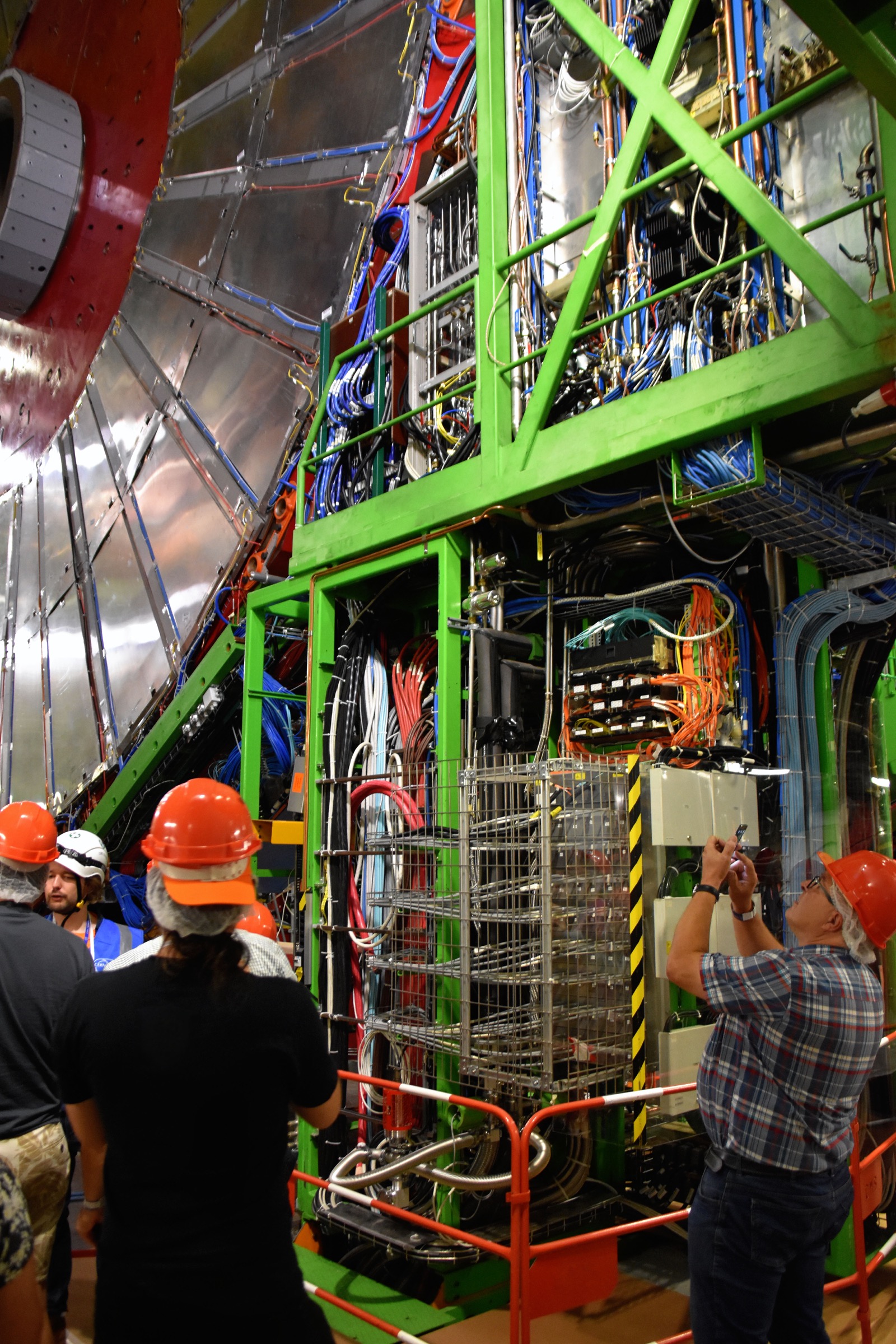
The LHCb detector underwent a major upgrade between Run 2 and Run 3, completed in 2022. Nearly all sub-detectors were replaced with more advanced versions, transforming it into an essentially new instrument in terms of performance.
The most critical upgrade was the ability to read out data at the full 40 MHz collision rate, compared to the previous 1 MHz. This allows the system to process 30 times more data per second, opening the door to detecting extremely rare particles like the Xi-cc-plus that were previously lost in the data flood.
"This is the moment we have been waiting for since the detector upgrade. Finding a new particle at 7-sigma significance demonstrates that the upgraded detector is performing beyond expectations."
▸ This discovery validates the upgraded LHCb detector -- unlocking many more discoveries ahead
▸ Understanding heavy quarks brings physicists closer to physics beyond the Standard Model
▸ Related: Vera Rubin Observatory | NASA ESCAPADE
References
- CERN — LHCb Collaboration discovers new proton-like particle, March 2026
- Scientific American — Physicists discover a charmed new baryon, March 2026
- HotHardware — CERN's upgraded LHC makes first new particle discovery, March 2026
Frequently Asked Questions
The most common questions about the Xi-cc-plus baryon discovery at CERN.
Related Topics
Stay on top of trends
Bookmark this page and check back often for the latest updates and insights.