technology

Smartphone Sales Face Record Crash in 2026

Global smartphone shipments are falling at the fastest pace ever recorded. The culprit is not weak demand for phones — it is the insatiable appetite of AI data centers devouring the world's memory chip supply.

-13% YoY1.12B UnitsDRAM +40%
-13%
YoY shipment decline (IDC)
1.12B
Units forecast for 2026
$523
Record average selling price
+40%
DRAM price surge

Key Takeaways

  • IDC forecasts a 13% year-over-year decline to 1.12 billion units in 2026 — the sharpest contraction on record and the lowest volume since 2013.
  • The root cause is not consumer apathy but a supply-side crisis: AI data centers operated by Meta, Google, and Microsoft are consuming so much DRAM that mobile-grade memory prices have surged 40%.
  • Morgan Stanley slashed its 2026 smartphone forecast by 15%, while average selling prices are surging 14% to a record $523 as manufacturers pass on component costs.
  • The budget segment (sub-$200) is being devastated — bill of materials up 20-30% with shipments down 31% — while premium ($800+) phones continue growing at roughly 4%.
  • Samsung and Apple are best positioned to weather the storm thanks to vertical integration. Chinese OEMs like Xiaomi and Oppo face a margin squeeze as they lack in-house memory sourcing.
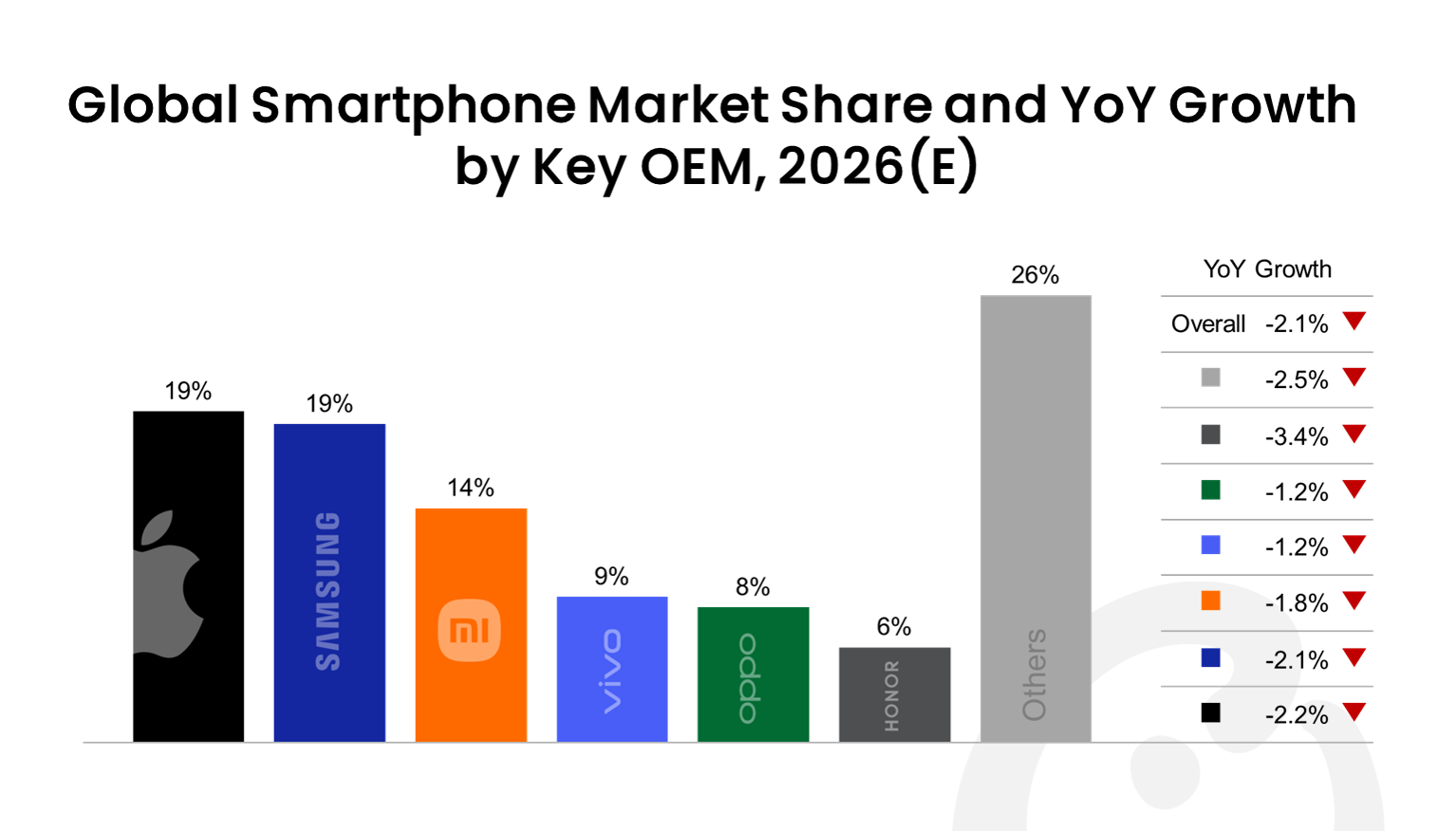
Smartphone shipment decline chart showing sharpest drop on record in 2026
Photo: Counterpoint Research

How AI Data Centers Are Starving Smartphones of Memory

The smartphone industry's unprecedented decline traces directly to a single chokepoint: DRAM. The same memory chips that power your phone's multitasking are also the lifeblood of AI training clusters. And right now, AI is winning the bidding war. Meta, Google, and Microsoft collectively ordered over 60% of global HBM3E (high-bandwidth memory) output in the first quarter of 2026. This voracious demand has cascaded through the entire memory supply chain. Samsung and SK Hynix — which together control roughly 70% of global DRAM production — have reallocated fabrication capacity toward high-margin server memory, leaving mobile-grade DRAM in chronic shortage. The result is brutal arithmetic for phone makers. A mid-range phone that required $18 worth of DRAM in 2024 now needs $25-30 for the same capacity. Multiply that across hundreds of millions of units, and the industry faces billions in additional component costs. Manufacturers have two choices: absorb the hit on already-thin margins, or raise prices and watch volumes collapse. Most are choosing the latter.

Budget vs. Premium: Two Markets, Two Fates

Budget (Sub-$200)Premium ($800+)
Shipment trend-31% YoY collapse+4% steady growth
BoM cost impact+20-30% devastating+8-12% manageable
Consumer responseDelaying upgradesTrading up for AI features
OEM marginNear-zero or negative15-25% healthy
Key playersXiaomi, Realme, TranssionApple, Samsung, Google

We are witnessing a historic reallocation of semiconductor resources from consumer electronics to AI infrastructure. The smartphone industry is collateral damage in the race to build artificial general intelligence.

Counterpoint Research, March 2026

Winners and Losers in the Memory Crisis

Samsung Electronics

Dual advantage: profits from selling expensive DRAM to AI clients while its Galaxy line absorbs cost increases better than rivals

Apple iPhone

Long-term memory contracts and massive purchasing power insulate iPhone from worst price spikes; premium demand intact

Xiaomi & Oppo

Squeezed hardest — reliant on spot-market memory purchases with razor-thin margins in the sub-$300 segment

Emerging Markets

Africa, India, and Southeast Asia hit hardest — affordable phones becoming less affordable, digital divide widening

Memory Makers (SK Hynix, Micron)

Record profits as AI demand pushes DRAM prices up 40% — but facing regulatory scrutiny over supply allocation

AI Giants (Meta, Google, Microsoft)

Securing memory at any price — their infrastructure buildout is directly responsible for the smartphone supply crunch

How the Crisis Unfolded

Q4 2025

DRAM prices begin accelerating as AI orders surge

Samsung and SK Hynix announce major capacity reallocation from mobile to HBM3E server memory. Spot prices rise 15% in a single quarter.

If you planned to buy a mid-range phone for $250, that same spec now costs $290-310 — an extra month of mobile bills for many families.
Jan 2026

IDC issues historic downgrade: -13% forecast

IDC revises 2026 global smartphone forecast from 1.29 billion to 1.12 billion units — the sharpest single-year downward revision in the firm's tracking history.

170 million fewer phones means 170 million people worldwide keeping old devices longer — slower apps, security vulnerabilities, missed features.
Feb 2026

Morgan Stanley cuts forecast by 15%, warns of 'structural shift'

Analysts at Morgan Stanley downgrade the entire smartphone supply chain, noting that AI memory demand is not cyclical but structural — this is the new normal.

For investors holding Qualcomm or MediaTek stock, this signals a multi-year headwind — not a one-quarter dip.
Mar 2026

ASP hits record $523 as budget segment collapses

Average selling price surges 14% to an all-time high of $523. Sub-$200 shipments crater 31% while premium $800+ grows 4%. The smartphone market is bifurcating.

In Vietnam, a Xiaomi Redmi that cost 3.5 million VND last year now runs 4.5-5 million VND — pushing budget buyers toward used phones or longer upgrade cycles.

The AI Infrastructure Arms Race Behind the Shortage

To understand why your next phone costs more, follow the money. In the first quarter of 2026 alone, Meta committed to spending $115-135 billion on AI infrastructure. Google allocated $75 billion. Microsoft budgeted over $80 billion. Each of these companies needs vast quantities of high-bandwidth memory (HBM) for their GPU clusters — and that memory comes from the same fabrication lines that produce mobile DRAM. SK Hynix, the world's largest HBM manufacturer, has publicly stated it cannot satisfy both AI and mobile demand simultaneously. The company's Icheon facility in South Korea has been converted almost entirely to HBM3E production. Samsung's Pyeongtaek mega-fab tells a similar story: server memory commands 3-4x the margin of mobile memory, making the business decision obvious. The consequences ripple outward. Qualcomm's Snapdragon 8 Gen 4 chips sit in warehouses because OEMs cannot source enough DRAM to pair with them. MediaTek has delayed two mid-range chipset launches. Even Apple, with its legendary supply chain management, has reportedly secured memory allocations through 2027 at above-market prices — a cost that will eventually reach consumers.
Digital Divide Warning
With sub-$200 phones becoming scarce, an estimated 400 million people in emerging markets may be priced out of smartphone ownership by 2027. The UN ITU has flagged memory allocation as a growing digital equity concern.

This is not a demand problem — consumers want to buy phones. It is a supply allocation problem driven by the economics of AI. Memory makers are rationally choosing higher-margin AI customers over lower-margin mobile OEMs.

Morgan Stanley Equity Research, February 2026

What Happens Next: Three Scenarios for 2027

Scenario 1 — Capacity Expansion: Samsung and SK Hynix complete new fabrication lines by late 2027, easing the DRAM crunch. Smartphone volumes recover to 1.2 billion units but never return to the 1.4 billion peak. This is the consensus view. Scenario 2 — AI Acceleration: Demand for AI memory outpaces new capacity. Smartphone volumes drop further to 1.0 billion units. The sub-$200 segment effectively disappears from developed markets. Feature phones make a comeback in emerging markets. Scenario 3 — Industry Adaptation: OEMs adopt new architectures — compute-on-memory designs, aggressive chiplet strategies, and cloud-offloaded processing — that reduce per-device DRAM requirements by 30-40%. Innovation born from scarcity. Regardless of scenario, one structural change is permanent: the smartphone industry will never again be the primary customer for memory chips. AI infrastructure has claimed that crown, and the mobile industry must adapt to being a secondary market for the semiconductor resources it once dominated.

Frequently Asked Questions

HD
By Hoa Dinh · Founder & Senior Tech Editor
Published: March 27, 2026
technology·smartphone shipments 2026 · memory chip shortage · phone prices 2026 · IDC smartphone forecast
Share

Related Topics

smartphone shipments 2026memory chip shortagephone prices 2026IDC smartphone forecastSamsung Apple salesAI data center memoryDRAM price surgesmartphone market decline

Stay on top of trends

Bookmark this page and check back often for the latest updates and insights.