US-Indonesia Sign Major Defence Partnership for Asia-Pacific
Hegseth and Indonesia's defence minister signed cooperation agreement at Pentagon focusing on maritime and autonomous systems.
Photo: Reuters via Al Jazeera
Key Takeaways
- US Defense Secretary Pete Hegseth and Indonesian Deputy Defence Minister Sjamsoeddin signed a defence cooperation agreement at the Pentagon on April 14, 2026.
- The agreement focuses on maritime cooperation, subsurface systems, and autonomous technology.
- The US is seeking overflight access through Indonesian airspace — a politically sensitive issue.
- Indonesia characterizes the deal as "preliminary, non-binding" amid its non-aligned posture.
- Over 170 joint military exercises are conducted annually between both countries.
Agreement Details
The US–Indonesia defence cooperation agreement was signed at the Pentagon on April 14, 2026, between US Defense Secretary Pete Hegseth and Indonesian Deputy Defence Minister Sjamsoeddin. According to reporting by Al Jazeera, the deal encompasses maritime cooperation, subsurface systems, and autonomous technology, marking a significant step forward in the bilateral defence relationship.
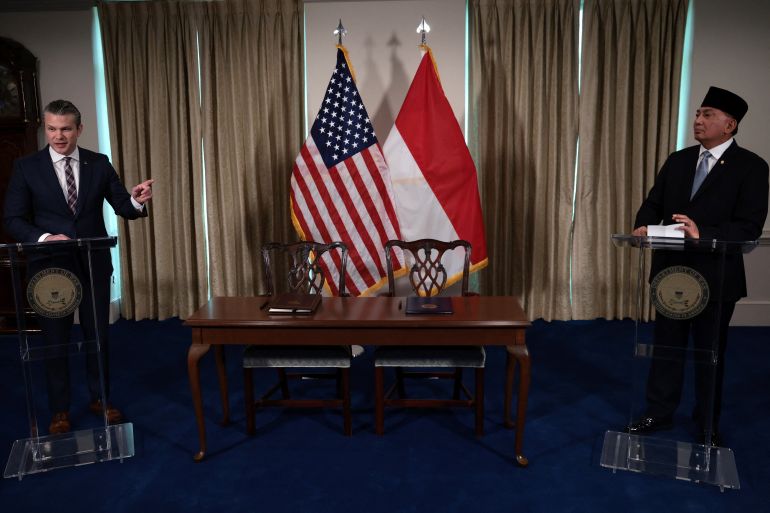
Hegseth described the agreement as a move that "bolsters regional deterrence." For Washington, Indonesia — the world’s largest archipelago nation with over 17,000 islands — is a key strategic partner in controlling critical maritime corridors across Southeast Asia.
Joint patrols, maritime intelligence sharing, sea-lane security
Submarine cooperation, seabed exploration systems
Drones, unmanned vehicles, military AI applications
170+ joint military exercises conducted annually
Maritime Cooperation
Indonesia controls three critical international sea lanes: the Strait of Malacca, the Lombok Strait, and the Sunda Strait. Approximately 40% of global maritime trade passes through these corridors, according to UNCTAD estimates. Enhanced maritime cooperation enables both sides to conduct joint patrols, share intelligence, and coordinate against piracy, smuggling, and illegal fishing.
World's busiest oil shipping lane, ~25% of global maritime trade
Alternative route for larger vessels, links Indian and Pacific Oceans
Shipping corridor between Java and Sumatra
▸ If you import/export through Southeast Asia, US–Indonesia maritime cooperation could reduce shipping risks and stabilize logistics costs.
Overflight Access Controversy
One of the most sensitive aspects of the agreement is the US pursuit of overflight access through Indonesian airspace. Given Indonesia's geographic position between the Indian and Pacific Oceans, its airspace provides the shortest route for rapid US air force deployment in the region. However, Indonesia adheres to a non-aligned foreign policy (bebas-aktif), and granting US military overflight access could trigger domestic political backlash.
Indonesia emphasized this agreement is "preliminary, non-binding." Jakarta seeks to maintain balance between its relationships with the US and China while preserving its traditional non-aligned stance.
▸ Indonesia's non-aligned policy (bebas-aktif) mirrors Vietnam's own balancing act — both seek to navigate between major powers.
Indo-Pacific Strategy Context
This agreement sits within Washington's broader strategy of building an alliance network across the Asia-Pacific. Amid the ongoing Iran conflict and escalating tensions with China in the South China Sea, the US is diversifying security partners beyond traditional allies like Japan, South Korea, and Australia.

US withdraws from NATO amid Iran war, redirects resources to Asia
Increased US Navy presence in the South China Sea
Signs defence cooperation deal with Indonesia
Negotiations to upgrade cooperation with Philippines and Vietnam
▸ For Southeast Asia, increased US military presence presents both a security opportunity and a geopolitical risk if nations are forced to choose sides.
ASEAN Implications
Indonesia is ASEAN's founding member and largest economy. Any defence agreement between Jakarta and Washington creates a ripple effect across the bloc. If Indonesia tilts toward the US, nations like Vietnam, the Philippines, and Singapore may feel similar pressure. Conversely, countries like Cambodia and Laos, which maintain close ties with Beijing, may lean further toward China.
Vietnam–US Defence Comparison
Vietnam upgraded its relationship with the US to a Comprehensive Strategic Partnership in September 2023 — the highest level in Vietnam's diplomatic framework. However, Vietnam–US defence cooperation remains more cautious than Indonesia's, focusing primarily on coast guard operations, mine clearance, and humanitarian assistance.
| Criteria | US–Indonesia | US–Vietnam |
|---|---|---|
| Joint exercises/year | 170+ | ~10–15 |
| Submarine cooperation | Yes | Not yet |
| Overflight access | Under negotiation | No |
| US arms purchases | F-16, Apache | Minimal |
| Relationship level | Strategic Partnership | Comprehensive Strategic P. |
▸ Vietnam holds a higher diplomatic tier but lags in actual military cooperation with the US compared to Indonesia. This deal may signal Hanoi to define its defence cooperation more concretely.
The China Factor
China is Indonesia's largest trading partner, with bilateral trade exceeding $130 billion in 2025, according to Indonesia's Ministry of Trade data. Beijing will undoubtedly monitor this deal closely. However, analysts suggest Indonesia is playing a shrewd diplomatic game: leveraging US–China competition to extract maximum benefits from both sides.
- Potential Chinese economic retaliation
- Polarization within ASEAN
- Regional military escalation
- Military equipment modernization
- Stronger negotiating position with China
- Attract US defence investment
▸ With China–Indonesia trade exceeding $130 billion, any shift could impact import prices across Southeast Asia.
Regional Security Outlook
The US–Indonesia deal marks a gradual shift in Southeast Asian security architecture. ASEAN, long built on consensus and non-interference principles, faces a new reality: its members are increasingly divided on where to lean. ZestLab analysis suggests this trend will accelerate in the second half of 2026.
Deal stays preliminary, no escalation. ASEAN maintains balance.
Agreement expands to military bases, overflight access granted.
Beijing applies economic pressure or increases military presence in the South China Sea.
* Probability estimates per ZestLab analysis, April 2026
Related Analysis
References
- Al Jazeera — US, Indonesia sign major defence cooperation agreement (April 14, 2026)
- UNCTAD — Global maritime trade estimates
- Indonesia Ministry of Trade — China–Indonesia bilateral trade data 2025
Related Topics
Stay on top of trends
Bookmark this page and check back often for the latest updates and insights.