Artemis II: NASA Crew Returns to Earth After Historic Lunar Flyby — Records Broken
science

Artemis II: NASA Crew Returns to Earth After Historic Lunar Flyby — Records Broken

NASA's Artemis II crew splashed down in the Pacific on April 11, 2026 after a 9-day, 252,756-mile lunar journey — the farthest humans have ever flown from Earth, and the first crewed return to the Moon in 54 years.

252,756 mi9 days, 1h 32m4 astronauts
252,756
Miles from Earth (record)
9d 1h 32m
Total mission duration
4,067
Miles — closest lunar approach
7,000+
High-res lunar images captured

Key Takeaways

  • Artemis II splashed down in the Pacific Ocean off the coast of San Diego at 12:29 PM ET on April 11, 2026 — exactly 9 days, 1 hour, and 32 minutes after launch from Kennedy Space Center.
  • The crew traveled 252,756 miles (406,771 km) from Earth — surpassing Apollo 13's 1970 record of 248,655 miles by 4,101 miles, a record that stood unchallenged for 56 years.
  • Christina Koch became the first woman to fly around the Moon. Jeremy Hansen became the first Canadian on a lunar mission. Victor Glover became the first African American to leave low-Earth orbit.
  • Orion capsule 'Integrity' endured re-entry temperatures of 3,000°F (1,649°C) and 3.9G of deceleration — successfully validating the AVCOAT heat shield design that will carry Artemis III astronauts back from the Moon's surface.
  • Total journey: 700,237 miles (1,126,922 km) — equivalent to circling Earth roughly 28 times. The mission opens the door to Artemis III, NASA's planned crewed lunar landing at the Moon's south pole.
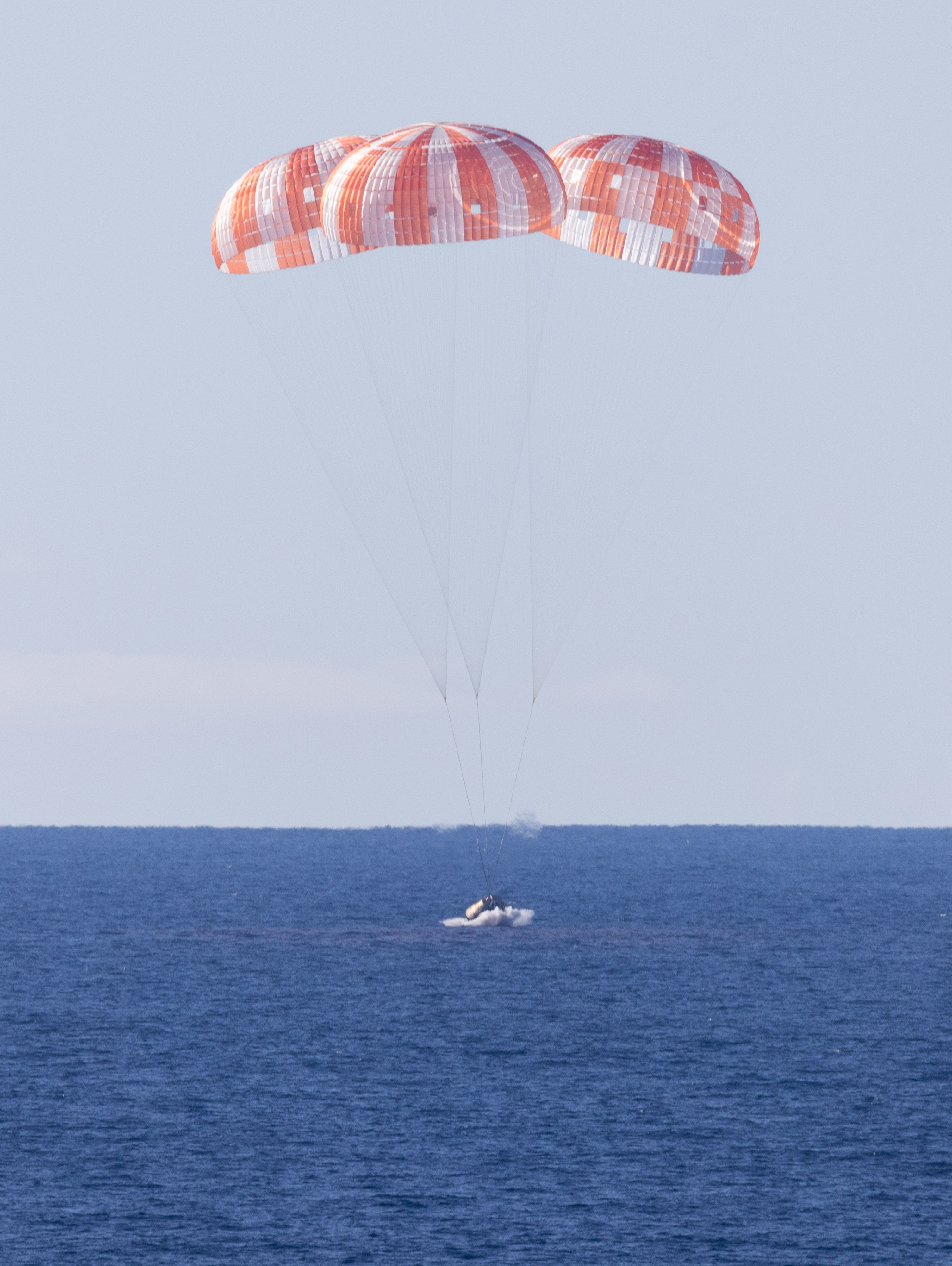
NASA Orion spacecraft Integrity descending on parachutes toward Pacific Ocean during Artemis II splashdown
Photo: NASA

What Artemis II Actually Did — And Why It Matters

Artemis II was not a Moon landing. The four-person crew never touched the lunar surface. Instead, the mission was a free-return flyby — a precisely calibrated trajectory that loops around the Moon and returns to Earth using only the Moon's own gravity, without firing engines for orbital capture. The purpose was to validate every system in the Artemis architecture under real crewed conditions before NASA commits people to a lunar landing. Orion's life support handled four humans for over nine days. The European-built Service Module kept the spacecraft pointed, powered, and propelled. The Deep Space Network maintained communication at the farthest range any crewed mission has ever required. And the heat shield — the single piece of hardware most likely to fail on Apollo-era missions — was tested for the first time at lunar-return velocity with people inside. Everything worked. That is the headline. Not the records, not the imagery, not the celebrity moments — but the fact that nine consecutive days of crewed deep-space operations passed without a single mission-threatening anomaly.
▸ Artemis III now has a green-light dataset. The 9-day clock just became the operational baseline for every future crewed lunar program — including SpaceX Starship HLS and Lockheed's Orion roadmap.

Artemis II vs. Apollo 13: The 56-Year Distance Record

MetricApollo 13 (1970)Artemis II (2026)
Max distance from Earth248,655 mi252,756 mi
Reason for recordEmergency free-return after O₂ tank rupturePlanned trajectory test
Crew size3 (all American men)4 (multinational, first woman + first Canadian)
SpacecraftOdyssey + Aquarius (CSM-109 / LM-7)Orion 'Integrity' (CM-003)
Mission outcomeSurvived but landing abortedFully successful flyby and return
Total distance traveled~622,268 mi (estimated)700,237 mi

Artemis II Mission Timeline

Apr 1, 2026 — 04:09 EDT

Liftoff from Pad 39B

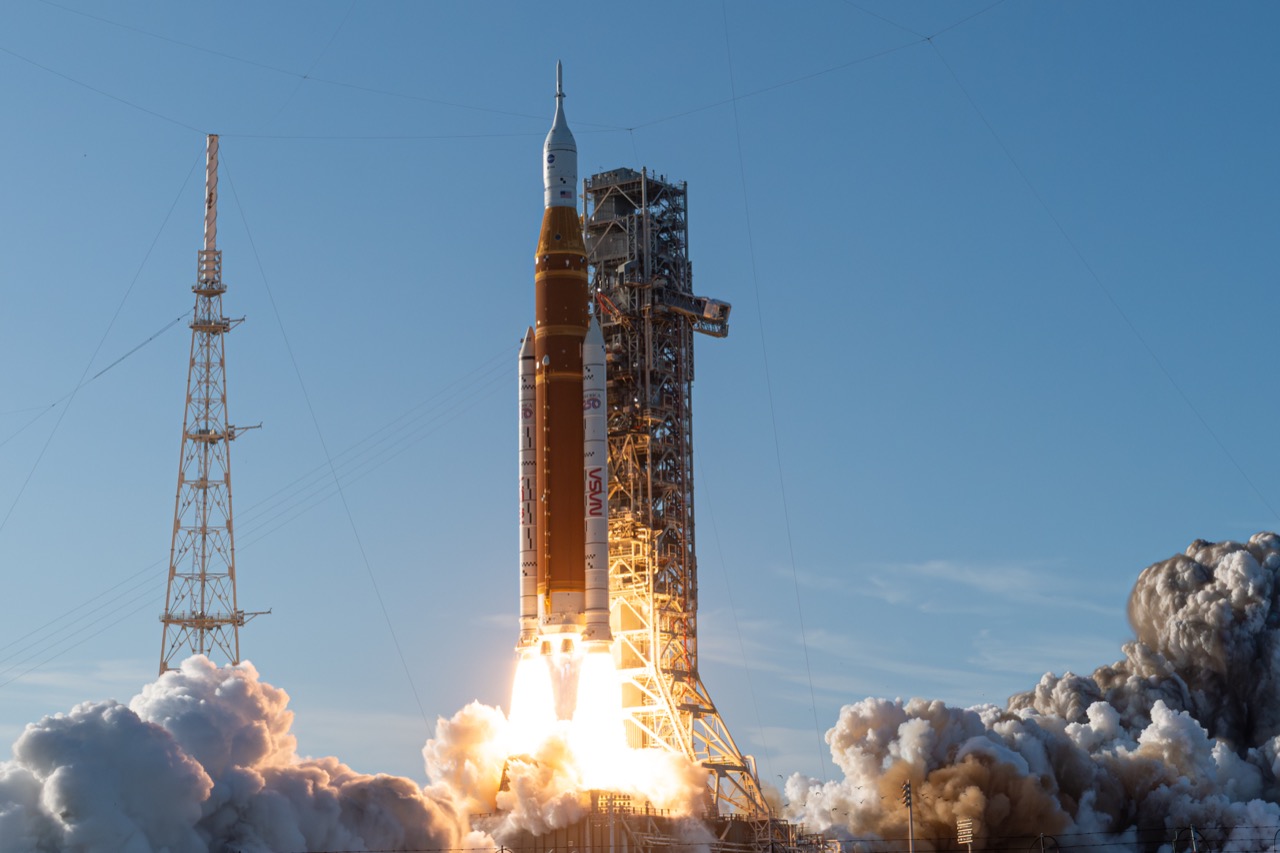
The Space Launch System Block 1 rocket lifted off from Launch Complex 39B at Kennedy Space Center, Florida — the same pad that launched Apollo 10 and Apollo 17. Eight minutes later, Orion separated from the core stage and entered a high-energy parking orbit.

▸ Second-ever crewed SLS launch — and the first time astronauts rode the rocket. The November 2022 Artemis I flight carried only mannequins.
Apr 1, 2026 — ~05:35 EDT

Trans-Lunar Injection Burn

The Interim Cryogenic Propulsion Stage fired for about 18 minutes, accelerating Orion to roughly 24,500 mph (39,400 km/h) and committing the spacecraft to a lunar trajectory. Within minutes, Orion separated from the ICPS and began its solo cruise.

▸ At TLI velocity, Orion was moving fast enough to cross the contiguous United States in under 7 minutes.
Apr 6, 2026 — 11:43 EDT

Closest Lunar Approach — 4,067 mi

Orion swept 4,067 miles (6,545 km) above the lunar far side — the closest crewed lunar approach since Apollo 17 in December 1972. The crew became the first humans in 54 years to see the Moon's far side with unaided eyes through the Orion windows.

▸ Christina Koch became the first woman to see the lunar far side directly. The Apollo program was entirely male.
Apr 6, 2026 — 19:50 EDT

Apollo 13 Distance Record Broken

Orion crossed the 248,655-mile mark and continued outward, eventually reaching 252,756 miles (406,771 km) from Earth — the farthest any human has ever traveled. Mission Control in Houston acknowledged the milestone with a planned radio call to the crew.

▸ Apollo 13's record was set during a life-threatening emergency. Artemis II broke it deliberately — the same number, achieved with intent rather than crisis.
Apr 7–10, 2026

Return Coast and Systems Checks

Orion coasted back toward Earth under the Moon's gravitational slingshot. The crew ran scheduled life-support tests, captured more than 7,000 high-resolution lunar images, and rehearsed re-entry procedures. Hansen and Glover conducted an Earth-pointing photometric survey of major ocean basins.

▸ The 7,000+ images include the highest-resolution crewed photography of the lunar far side in over five decades.
Apr 11, 2026 — 12:29 EDT

Splashdown in the Pacific

Orion 'Integrity' splashed down approximately 200 miles southwest of San Diego, decelerating from 24,500 mph to 17 mph through the atmosphere using the AVCOAT heat shield and 11 parachutes. USS John P. Murtha was on-station within minutes; Navy divers attached an inflatable collar and the crew was hoisted aboard by helicopter.
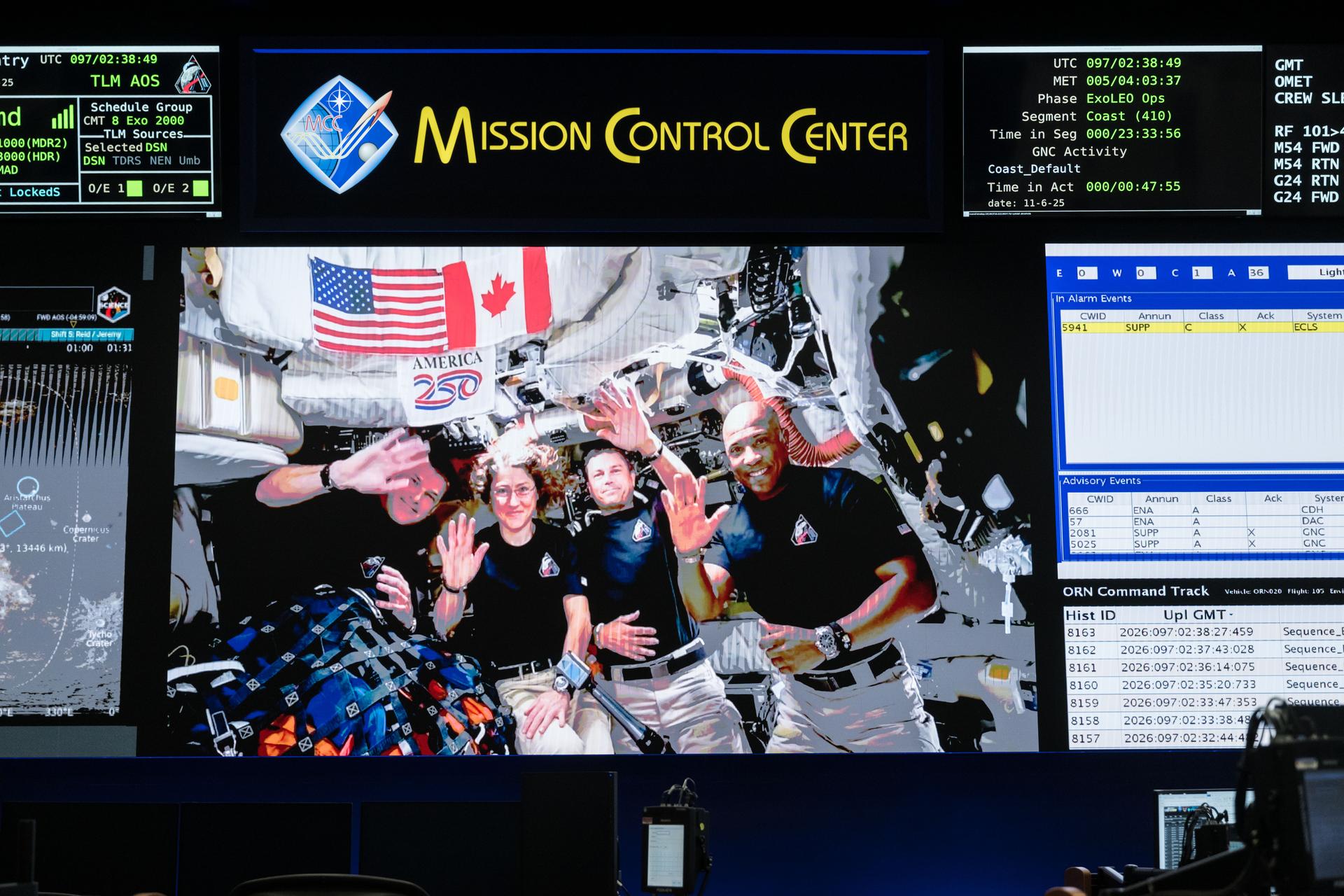
▸ Total mission elapsed time: 9 days, 1 hour, 32 minutes — within 4 minutes of the pre-launch flight plan. NASA Flight Director Rick LaBrode called it 'the cleanest deep-space mission we've ever flown.'
Mission Control Center screen displaying Artemis II crew waving inside Orion capsule after lunar flyby
Photo: NASA

Meet the Artemis II Crew

Reid Wiseman — Commander (NASA)

Former U.S. Navy test pilot. Logged 165 days on the ISS during Expedition 41 in 2014. Selected as Artemis II commander in April 2023 — the role that made him the first American to command a lunar mission since Apollo 17's Eugene Cernan.

Victor Glover — Pilot (NASA)

U.S. Navy aviator and former SpaceX Crew-1 pilot. First African American to live on the ISS for a long-duration mission. With Artemis II, he became the first African American to leave low-Earth orbit and the first to fly around the Moon.

Christina Koch — Mission Specialist (NASA)

Holds the record for longest single spaceflight by a woman (328 days, 2019–2020). With Artemis II, she became the first woman in history to fly around the Moon — closing a 54-year gap in which only male astronauts had reached lunar distance.

Jeremy Hansen — Mission Specialist (CSA)

Royal Canadian Air Force CF-18 fighter pilot, selected by the Canadian Space Agency in 2009. Artemis II was his first spaceflight — and made him the first non-American astronaut to fly to the Moon.


The Real Test: Re-Entry and the Heat Shield

For NASA engineers watching from Houston, the single highest-stakes moment of Artemis II was not the lunar flyby — it was the final 30 minutes of re-entry. Orion plunged into the upper atmosphere at roughly 24,500 mph (Mach 32), far faster than any spacecraft returning from low-Earth orbit. The AVCOAT heat shield — a fresh formulation tested unmanned on Artemis I in 2022 — had to dissipate kinetic energy equivalent to a small nuclear detonation, peaking at 3,000°F (1,649°C) of surface heat. The crew experienced 3.9G of deceleration: roughly four times their body weight pressing them into the contoured seats. Drogue chutes deployed at 25,000 feet, followed by three pilot parachutes and three 116-foot main parachutes that slowed Orion to its 17 mph splashdown velocity. The entire descent — from atmospheric interface to ocean — took approximately 25 minutes. Post-mission inspection of Integrity's heat shield revealed substantially less material loss than expected — a critical data point for Artemis III, where a crew returning from the lunar surface will hit the atmosphere at the exact same velocity. Without the Artemis II validation, NASA would have flown Artemis III with an unproven heat shield carrying astronauts back from lunar orbit. That risk now no longer exists.
▸ Of every Apollo-era system NASA had to re-engineer for Artemis, the heat shield carried the most schedule risk. Integrity's clean return just removed it.

We just flew the cleanest deep-space mission we've ever flown. Every system performed at or above expectation. Artemis III is now a more credible mission than it was 10 days ago.
Rick LaBrode, NASA Flight Director — post-splashdown press briefing (Apr 11, 2026)
NASA Space Launch System rocket lifting off from Launch Complex 39B at Kennedy Space Center on April 1 2026
Photo: NASA

What This Means for Vietnam and Asia-Pacific Space Watchers

Vietnam does not have a crewed space program, but it does have a national satellite roadmap — Vinasat-1, Vinasat-2, MicroDragon, and the planned LOTUSat-1 Earth observation satellite. The successful Artemis II splashdown matters to Hanoi's policy planners for two reasons. First, validated US lunar capability resets the calculus for international partnership tracks. The Artemis Accords — to which Vietnam is not yet a signatory but neighbors Singapore and Japan are — gain credibility every time the program ships a clean mission. Universities in Hanoi and Ho Chi Minh City that have submitted CubeSat proposals to NASA's University Student Launch Initiative now have a more concrete commercial pipeline to track. Second, the broader space economy that Artemis is anchoring — projected by Morgan Stanley to reach $1.8 trillion by 2035 — directly affects the components Vietnam already manufactures. Electronic assemblies from Bac Ninh and Hai Phong already feed into Tier-2 aerospace supply chains. A successful Artemis II means more contracts moving through that chain, and more pressure to upgrade FDI-driven manufacturing capacity toward space-grade quality standards.
▸ If a Vietnamese electronics fab earns even one space-grade certification this decade, expect FDI inflows on the order of hundreds of millions USD. Artemis II just made that certification path more credible.
About this article
This article is for informational purposes only. Mission timings, distances, and crew details are sourced from NASA news releases, mission blogs, and the post-splashdown press briefing on April 11, 2026. All figures are reported as published; subsequent NASA technical reviews may refine specific telemetry values.

Frequently Asked Questions

Published: May 23, 2026. This article is for informational and educational purposes only. All data sourced from official NASA communications and verified reporting cited above.
DP
By David Park · Deep Tech & Quantum Correspondent
Published: May 23, 2026
science·NASA moon mission 2026 · Orion capsule splashdown · Artemis II crew return Earth · NASA lunar flyby record
Share

Related Topics

NASA moon mission 2026Orion capsule splashdownArtemis II crew return EarthNASA lunar flyby recordArtemis II mission 2026NASAMoonOrionArtemis

Stay on top of trends

Bookmark this page and check back often for the latest updates and insights.