Gaganyaan G1: India Reaches for Space with Robot Vyommitra
ISRO targets late March 2026 for Gaganyaan-1, India's first uncrewed orbital test flight carrying humanoid robot Vyommitra, paving the way for crewed missions in 2027.
India's Historic Human Spaceflight Milestone
Gaganyaan-1 represents the culmination of over a decade of ISRO preparation. With 8,000+ ground tests, a specifically human-rated GSLV Mk III rocket, and humanoid robot Vyommitra flying as crew surrogate, G1 will validate all critical systems before humans board in 2027.
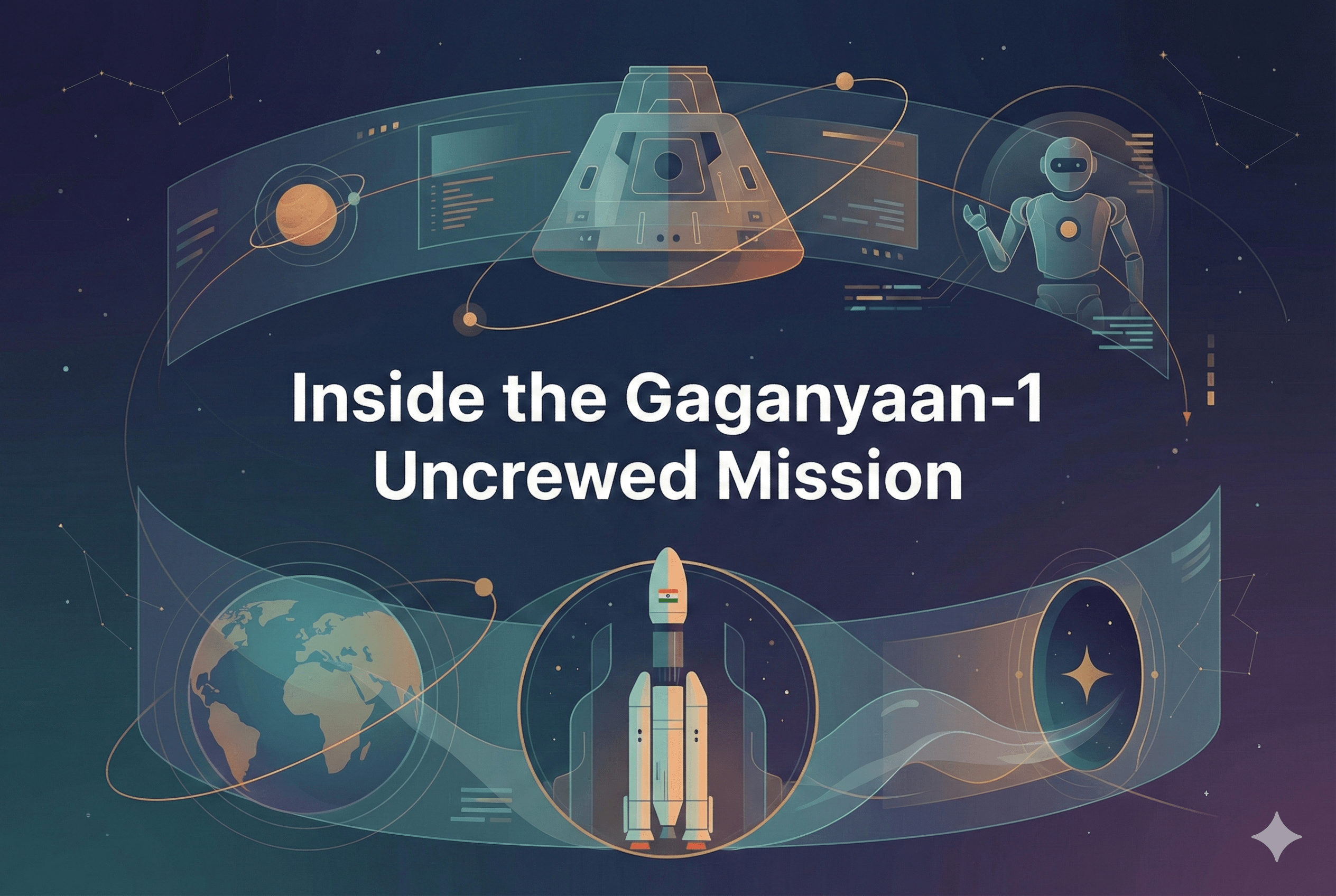
Photo: Swarajya Magazine — ISRO Gaganyaan crew module
What Makes Gaganyaan Historic
From robot Vyommitra to 8,000+ ground tests, from a 400 km orbit to the ambition of becoming the 4th nation — every aspect of Gaganyaan carries deep historic significance.
Vyommitra Robot on G1
Vyommitra is ISRO's advanced humanoid robot flying as crew surrogate on Gaganyaan-1. It monitors cabin parameters, operates switches, and interacts with the life support system — collecting critical data for the crewed H1 mission.
[1] Swarajya Magazine8,000+ Ground Tests Completed
ISRO has completed over 8,000 ground tests — reflecting an extremely conservative approach to human spaceflight safety. The GSLV Mk III rocket was specifically human-rated for the Gaganyaan program.
Low Earth Orbit — 400 km
The crewed H1 mission will place three Gaganauts in low Earth orbit at approximately 400 km altitude for up to 7 days — the same orbital range as the International Space Station.
[1] Wikipedia — Gaganyaan4th Nation to Independently Launch Humans
If the H1 mission succeeds, India will join the exclusive club of the United States, Russia, and China as the fourth nation capable of independently launching humans to space — a major geopolitical and scientific milestone.
Vyommitra: India's Spaceflight Pioneer
Before any Gaganaut climbs into the cockpit, ISRO's advanced humanoid robot Vyommitra will make the first journey — monitoring critical systems, simulating crew actions, and gathering irreplaceable data in real space conditions.
Photo: NASA — Astronauts conducting spacewalk operations
Cabin Monitoring
Continuously monitors cabin pressure, temperature, humidity, and gas levels — validating the life support system under real orbital conditions.
Switch Operations
Vyommitra's robotic hands are designed to operate the spacecraft control panel — simulating human crew action sequences during critical mission phases.
Data Collection
Biological and environmental data from G1 will directly inform H1 crew habitat design, ensuring Gaganauts board a fully validated spacecraft.
From Announcement to Launch: The Gaganyaan Journey
Announced in 2018, Gaganyaan has undergone a decade of meticulous preparation. Each milestone reflects ISRO's commitment to safety reliability — placing crew lives above schedule.
Gaganyaan Announced
Prime Minister Modi announces the Gaganyaan program in his Independence Day address, targeting an Indian in space before 2022.
8,000+ Ground Tests
ISRO completes over 8,000 ground tests covering the crew module, launch abort system, life support, and human-rated GSLV Mk III rocket.
Pad Abort Test
ISRO successfully conducts the Crew Escape System (CES) pad abort test at Sriharikota, validating the critical safety system.
Gaganyaan-1 (G1) — Uncrewed Flight
ISRO targets late March 2026 for the first uncrewed orbital flight, carrying humanoid robot Vyommitra as crew surrogate.
Two More Uncrewed Test Flights
Two additional uncrewed test missions are planned to fully validate all spacecraft systems before humans board.
H1 — First Crewed Mission
Three Indian astronauts — called Gaganauts — will fly to low Earth orbit at approximately 400 km altitude for up to 7 days. India becomes only the 4th nation to independently launch humans to space.
Gaganyaan: Foundation for India's Space Future
Gaganyaan is not just a mission — it is the first step in India's ambitious space roadmap that includes an indigenous space station by 2035 and crewed lunar missions by 2040.
Photo: NASA — ISS solar array installation
Bharatiya Antariksha Station — India's planned space station by 2035 — will be the next step after Gaganyaan, enabling India to have a permanent orbital presence.
After the space station, ISRO plans a crewed lunar mission by 2040 — building on the foundations of Chandrayaan and Gaganyaan.
The first crewed mission carrying 3 Gaganauts to low Earth orbit. This is the foundational step for all of India's long-term space ambitions.
Frequently Asked Questions About Gaganyaan
▸ India will become the 4th nation to independently launch humans to space -- after the US, Russia, and China
▸ Over 8,000 ground tests completed -- the most cautious approach in crewed spaceflight history
▸ Related: Vera Rubin Observatory | NASA ESCAPADE