NASA Spacewalk Upgrades ISS Solar Arrays for Future Deorbit
Astronauts Jessica Meir and Chris Williams conducted a 6.5-hour spacewalk on March 18, 2026 to install the bracket for the 7th of 8 new roll-out solar arrays on the ISS, supporting its eventual controlled deorbit in 2030.
What Happened on March 18, 2026
Astronauts Jessica Meir and Chris Williams executed NASA's first spacewalk in approximately 10 months — installing the bracket structure for the 7th of 8 new roll-out solar arrays to upgrade ISS power systems and prepare for the station's controlled 2030 deorbit.
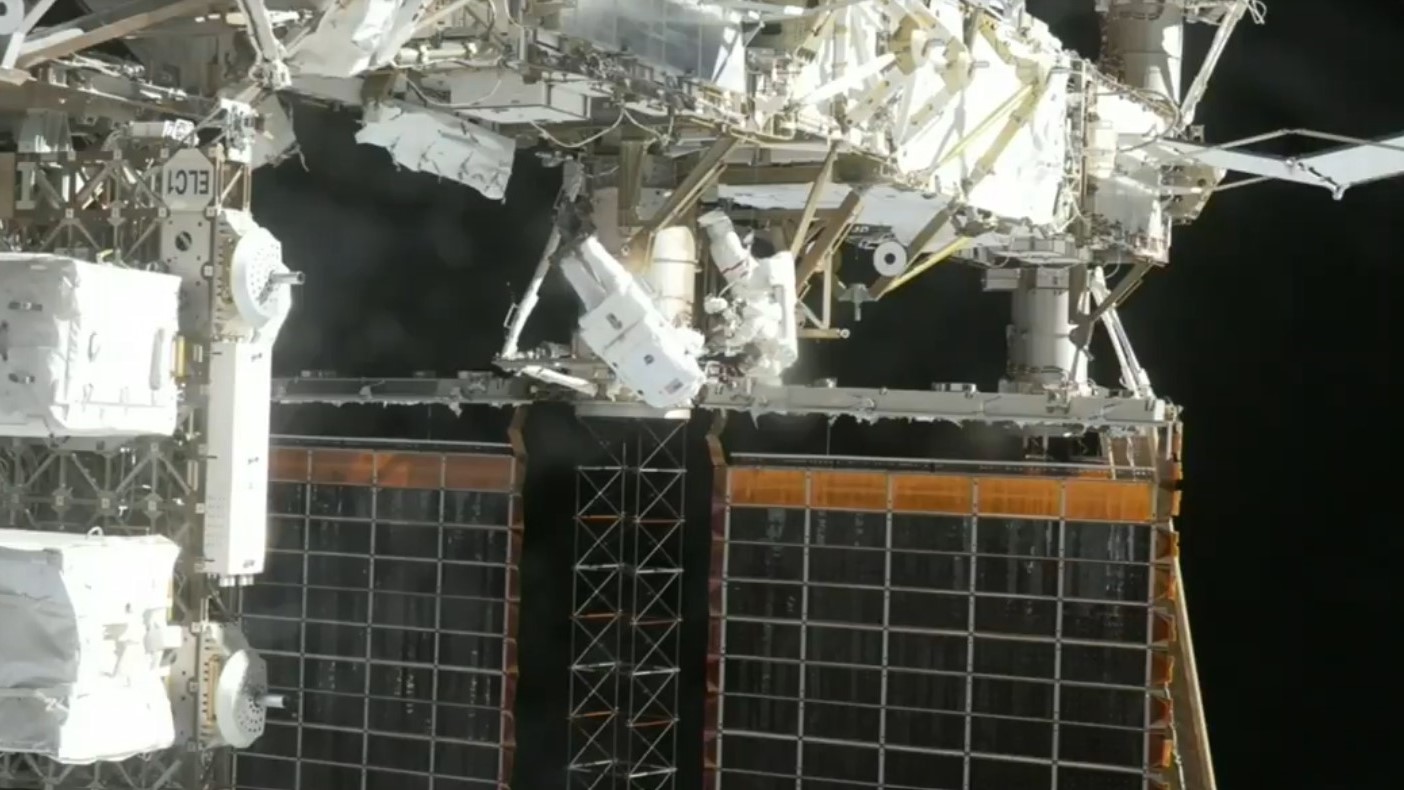
Photo: NASA — Astronauts Meir and Williams spacewalk outside ISS
How Does the iROSA Work?
The ISS Roll-Out Solar Array (iROSA) is an elegant engineering solution — a compact, self-deploying solar array requiring no motor, designed to supplement the ISS's aging original solar panels.
Motorless Roll-Out Design
The iROSA is stored rolled up like a carpet and self-deploys by unrolling outward using carbon composite boom structures — no motor required at all. The self-deployment process completes in approximately 6 minutes.
[1] NASA Blog — March 18, 2026Overlay on Aging Arrays
The iROSA panels are installed on top of the ISS's original solar arrays, which have degraded to approximately 60% of their original output after more than 25 years of exposure to space radiation and continuous thermal cycling.
Size & Power Output
Each iROSA measures 19 by 6 meters when fully deployed. All 8 arrays together add substantial electrical power, ensuring the ISS operates at full capacity through its remaining operational period and during the controlled 2030 deorbit.
[1] Space.com — EVA ReportSupporting the 2030 Deorbit
The upgraded power systems will supply the ISS's propulsion and attitude control systems during the multi-month deorbit process. Without the iROSAs, the power margin for deorbit operations would be insufficient.
Jessica Meir & Chris Williams: The EVA Team
Astronauts Jessica Meir and Chris Williams of Expedition 72 crew conducted the EVA on March 18, 2026 — NASA's first spacewalk in nearly 10 months. Their mission focused on installing the bracket assembly for the 7th iROSA on the port S6 truss segment.
Jessica Meir
Experienced astronaut with multiple previous EVAs on the ISS. Known for the first all-female spacewalk in 2019 alongside Christina Koch.
Chris Williams
Expedition 72 crew member, conducting this EVA as part of his long-duration mission aboard the International Space Station.
Photo: NASA — Astronaut spacewalking alongside ISS solar arrays in orbit
The iROSA Upgrade Roadmap: 2023 to 2026
The iROSA upgrade program began in 2023 and is expected to complete in 2026 with all eight arrays fully installed, ensuring the ISS has sufficient power for all remaining operations through deorbit.
iROSAs 1 & 2 Installed
NASA conducts the first spacewalks of the iROSA upgrade program, installing the first two roll-out solar arrays on the ISS.
iROSAs 3 & 4 Installed
Expedition 69 crew continues the upgrade program, installing two more iROSA panels, bringing the total to four.
iROSAs 5 & 6 Installed
After a pause in EVA operations, Expedition 71 crew installs iROSAs 5 and 6, adding substantial additional electrical capacity to the station.
EVA — iROSA 7 Bracket Install
Astronauts Jessica Meir and Chris Williams exit the ISS at 8:52 AM EDT, conducting a 6.5-hour EVA to install the bracket structure for iROSA 7 on the port truss. This is NASA's first spacewalk in approximately 10 months.
iROSA 8 — Program Complete
A final EVA will install the eighth and last iROSA panel, completing the entire ISS solar power upgrade program and ensuring the station has sufficient power for all remaining operations through 2030.
Why Does ISS Need Power Upgrades Before Deorbit?
The ISS is planned for a controlled deorbit in January 2030. This process requires reliable electrical power to operate propulsion and attitude control systems over several months. The iROSA program ensures the ISS has sufficient power margin for all these final operations.
Photo: NASA — ISS solar array installation
Deorbit Plan
NASA plans to deorbit the ISS in January 2030 with a controlled atmospheric reentry over the South Pacific Ocean.
Power Requirement
Propulsion and attitude control systems need reliable power during the multi-month deorbit process. iROSAs ensure sufficient power margin.
SpaceX Deorbit Vehicle
SpaceX is developing a private deorbit vehicle under a NASA contract to assist with the final deorbit burn in 2030.
A Week of Parallel EVAs: NASA & China
The same week as NASA's March 18 EVA, China's Tiangong space station also conducted a 7-hour EVA — a notable coincidence reflecting the parallel human spaceflight race between the two space powers.
6.5-hour EVA — Meir & Williams, iROSA 7 bracket install
7-hour EVA — Zhang Lu, 6th EVA (ties Chinese EVA record)
▸ If you are interested in space tourism, ISS will be decommissioned by 2030 — after which commercial stations (Axiom, Orbital Reef) may offer orbital tourism seats starting at $55M per trip.
Other space missions worth following include the Vera Rubin Observatory and the NASA ESCAPADE Mars mission.